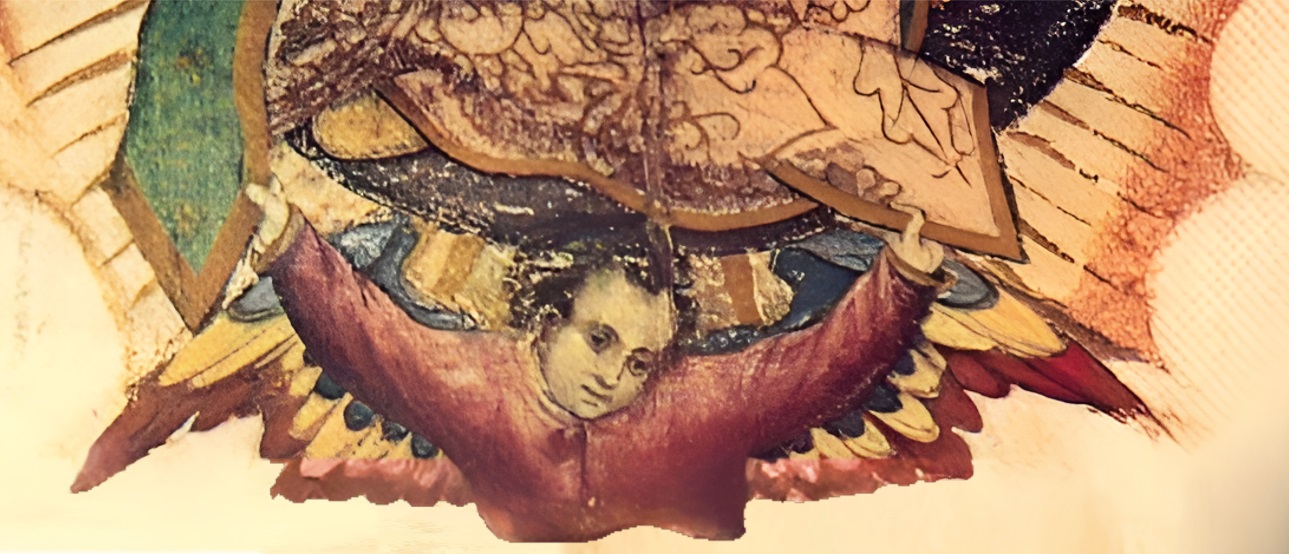
Probably no painting holds as many mysteries, nor has any been studied as extensively, as that of Our Lady of Guadalupe. Astronomers, physicians, engineers, and experts from a wide array of disciplines have examined every detail: the curious human-like temperature of the image, the pupils reflecting several figures with the triple reflection characteristic of a human eye,[1] the precise positioning of the 68 stars on the mantle,[2] and countless other phenomena.[3] Yet, little attention has been given to the angel who supports the Virgin and ties the entire scene to the events of the first Christmas. We dedicate this study to that mysterious angel, who retells the story of Christmas.
The Historical Issues of the Eagle Angel
Unfortunately, the angel lost much of its scientific appeal after the studies conducted by Americans Philip Serna Callahan and Jody Brant Smith between 1979 and 1983.[4] Serna photographed the Guadalupe image under infrared light and uncovered three significant findings. First, he identified a series of inexplicable phenomena in the depiction of the woman and her mantle. The colors were applied without the use of brushes or tools, utilizing pigments unknown to this day, and they do not touch the fabric—they appear to float above the surface.[5] The hues are exceptionally vibrant, as if they were painted yesterday. Second, it became evident that other parts of the image were more conventional, painted with ordinary brushes. It seems that the angel, the moon, the rays surrounding the maiden,[6] the arabesques on her gown, and the cross at her neck were later additions to the miraculously created image of December 12, 1531.[7] Third, Serna detected traces of other images and retouches from earlier periods that had since disappeared. For instance, remnants of a sixteenth-century crown and two cherubs painted on the sides in the seventeenth century were identified, both of which were later removed, along with evidence of various other modifications. These additions were already known, having been mentioned in historical documents.[8] Callahan concludes his study by stating that it was as if God and man had worked together to create this masterpiece. [9] One could even go further: the entire image appears to be the result of a collaborative effort of humanity, the angels, and God to honor this singular Lady.
We do not know with certainty when the angel, the moon, and the rays were painted, but all indications suggest it was very early on. The first known copy of the image appears in the Escalada Codex, which dates to 1548, seventeen years after the appearance.[10] There, as shown in the photographs, the moon is already depicted at Mary’s feet:
 | 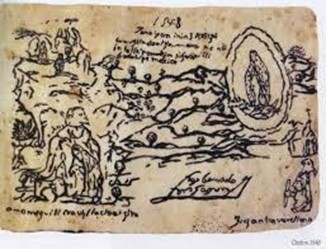 |
| Escalanda Codex of 1548 | Delineated Codex |
Later, we have a detailed description dated between 1543 and 1550, which mentions numerous elements of the image. It states that the Virgin possesses «a golden crown, tapered at the top and wider at the base,» that she stands on a moon with its horns pointing upward, describes one hundred rays surrounding the image, «some very long, others shorter, shaped like flames,» and finally refers to «an angel, visible only to the waist, as if emerging; and nothing of him appears below his feet, as if he were within the cloud.»[11] Thus, there is sufficient evidence to confirm that the angel and the moon were already present in the image by at least 1550.
Be it that the angel was painted by human hands or by divine brushes, its presence in the image is far from trivial. The fact that it may have been added ten or twenty years after the original image was created in 1531, and that it has remained unaltered ever since, speaks volumes. Compare this to other additions, such as the aforementioned cherubs, the crown, the cloud, and certain retouches, all of which disappeared relatively quickly. The mere fact that the angel has endured, nourishing popular devotion for nearly five centuries, establishes it as a locus theologicus (a source of theological knowledge) worthy of study. Furthermore, the matter gains even more depth from a Mariological perspective. It is reasonable to assert, without fear of error, that it was the Blessed Virgin herself who chose not to wear a crown in the image, preferring instead to appear as a humble mother. Let us recall that the temple on Mount Tepeyac and the tilma were entirely her idea. Likewise, she did not wish to be surrounded by multiple angels, but rather by one very special angel, the one who now rests at the feet of the Guadalupana. It is worth delving into the mysteries hidden by this small angel, whom the Virgin herself has chosen to place at her feet.
The Meaning of the Eagle Angel
At first glance, the angel appears to be just another childlike angel of the type typically depicted at Mary’s feet. Even this detail is significant. Christian iconography often portrays the highest-ranking spirits in the angelic hierarchy—cherubim and seraphim—as children. They are frequently painted in red to symbolize their intense love. Thus, the red-clad angel at the feet of the Guadalupana burns with divine love: love for the Messiah in the maternal womb and for the mother who carries him.
That the woman is pregnant is evidenced by three signs in the image: the elevated abdomen, the black ribbon beneath her hands—a symbol of pregnancy in the sixteenth century—and the fact that a stethoscope once detected a heartbeat in her womb measuring 115 to 120 beats per minute, characteristic of an unborn child.[12] For this reason, Mary is rightly called the «Ark of the Covenant,» the one who bears the salvation of humanity. Just as the Israelites adorned the Ark of the Old Covenant with cherubim crafted from solid gold,[13] it is fitting that God would choose to adorn with living cherubim the one who carried within her the New Covenant.
The meaning of the angel becomes even more astonishing when viewed through the lens of Aztec cultural categories. Observe how the angel’s face bears the features and complexion of a native Indian. Note how his outstretched arms hold the turquoise garment of the Virgin, a color reserved for Aztec emperors. Contemplate the eagle wings, fully spread as though soaring at the highest heights. For the Aztecs, the eagle was the bird that flew the highest and, therefore, came closest to the Sun. This sacred bird was tasked with carrying the hearts of sacrificial victims in its talons to feed the gods.[14] That humble angel, positioned at the feet of the pregnant Empress surrounded by the Sun, symbolized a young eagle warrior from the Aztec army, a force known as the «Soldiers of the Sun.»[15]
The image of Guadalupe, in its entirety, exudes peace. However, upon closer contemplation, there is something that does not quite align. On one hand, we see the maternal gaze with lowered eyelids and the calm face of the woman, suggesting she is absorbed in thought about the Savior she carries in her womb. Even the stars of the heavens find peace upon her mantle. Yet, while her serene eyes are directed to the left, the angel below looks toward the opposite side with a certain unease. His open, watchful eyes remain restless. Something beyond the frame has captured his attention. Where is he looking? What troubles him? We cannot know. One recalls events Mary did not witness during her pregnancy: the astronomical discoveries of the Magi, their conversations about a new King, and their decision to worship him; Herod’s vanity, already stained by the blood of his rivals; and the movements in the infernal realms, plotting against the extraordinary figure dwelling in the woman’s womb. All of this was unknown to Mary but well understood by her guardian angel. This, perhaps, was what troubled him.
The battle between the Eagle Angel and the Dragon
It is uncertain whether the demons knew that the newly conceived child was the eternal Father’s Son. Several theologians argue that they did not; that this truth only became evident to them when Satan tempted the Lord three times in the desert or later when Jesus himself openly declared it. Regardless, the infernal realms were deeply unsettled by the conversations circulating within Mary’s household, the words of the Archangel Gabriel, and the repeated mention of the «Savior.» Furthermore, they were certain that half of the genetic material of the one conceived in Mary’s womb had no human origin. The celestial angels appeared to be particularly active during those days, especially on Christmas Day, when they appeared to the shepherds to announce the birth of «a Savior, who is Christ the Lord.»[16]
Thus, a great scarlet dragon, with seven heads and ten horns—the same one who, in ancient times, had dragged a third of the stars from the heavens with his tail—stood alert, knowing the time of the great battle was near. Revelation narrates that the beast «stood before the woman who was about to give birth, so that it might devour her child as soon as it was born.»[17] But the child was taken up, «and the woman was given the two wings of the great eagle, so that she might fly from the serpent into the wilderness, to the place where she is nourished for a time, and times, and half a time.»[18]
All of this is narrated in figurative language, with a perspective more celestial than human. Clearly, the woman did not lose her human nature. The best interpretation of the apocalyptic passage is that, to overcome the powerful dragon, the woman was granted «the two wings of the great eagle,» symbolizing the powers of a high-ranking angel in heaven. Good and evil angels often act by persuading human beings to carry out their will. It is within this framework that the battle unfolded: while the demon incited Herod to orchestrate the massacre of Bethlehem’s newborns—and ultimately, the Messiah—Saint Gabriel warned Joseph to flee and guided the Magi to take a different path, while another eagle-winged angel guarded the Holy Family on their journey to Egypt. There, they seem to have remained under the angel’s protection for three and a half years.[19]
This interpretation aptly explains the concerned expression of the cherub with eagle wings in the Guadalupe image. Thus would be fulfilled the saying, «The angel of the Lord encamps around those who fear Him, and delivers them.»[20] It is striking, even ironic, that the great dragon and the fury of hell are powerless against a childlike angel, who emerges victorious alongside the Woman. Angelic battles are not like those depicted in Hollywood. The human mind struggles to fully grasp them. At the very least, it can be said that each spirit uses its own weapons: the demons wield fear, vanity, and cruelty, while the heavenly angels fight with humility, simplicity, and love. Thus is fulfilled the enigmatic prophecy written centuries earlier: «Out of the mouths of babes and nursing infants, You have ordained strength… to silence the enemy and the avenger.»[21]
Two additional details should be noted about the eagle angel. The small figure has no feet, and his right hand grips the star-studded turquoise mantle, while his left holds the Virgin’s inner garment. In Christian iconography, angels without feet, with contorted legs, or with legs that fade away, signify movement. The firm grip (not just a mere touch) on the Woman’s garments, while moving swiftly with eagle wings fully extended, reveals that he is flying with her somewhere. Where? To the wilderness. To Egypt, in flight from danger.
This form of transport also carries symbolic significance. In Aztec culture, only kings, queens, and high dignitaries were carried on the shoulders of others. Thus, the image depicts an Aztec eagle warrior carrying the Empress of the Universe on his shoulders. A high-ranking angel of heaven appears submissive before this Queen, who is rightly called “Queen of Angels” countless times. Yet, as already noted, the Virgin of Guadalupe did not wish to be portrayed as a crowned queen but as a humble mother. Her desire was for a temple to be built to help her children. Recall the language used in the apparitions: Juan Diego addressed her as «my littlest daughter, my girl, and my Lady,» and she, in turn, called him «my littlest son.» It seems that Mary would use the same tender language with the childlike angel at her feet. To him, too, those words may have been addressed to Juan Diego: «Am I not here, I who am your Mother? Are you not under my shadow? Am I not your health? Are you not in the fold of my arms?» If Scripture refers to angels as sons of God,[22] then in some way they may also be called children of the Mother of God.
Thus is told the story of Christmas from an angelic perspective: a story that, as we see, unleashed a battle between the greatest dragon of hell and a cherub that was flying high in the heavens. The image of Guadalupe has provided us with several clues to better understand the weapons used in this battle and to draw closer to the mystery of the infant spirit capable of overcoming any dragon. This was precisely the path God chose to defeat the pride and cruelty of the world: an infant God disarming the most arrogant. As Pope Francis said in Christmas 2021: “Today, all is turned upside down: God comes into the world in littleness. His grandeur appears in littleness.”[23]
Merry Christmas!
Juan Carlos Riofrío
Washington, D.C., December 24 de 2024
[1] This involves the Samson-Purkinje effect, which was entirely unknown in the XVI century. Alfonso Marcué was the first to discover in 1929 that, upon examining the negative of a photograph of the Virgin’s eye, the figure of a bearded man could be discerned. On May 29, 1951, photographer José Carlos Chávez confirmed Marcué’s discovery. Since then, over twenty ophthalmologists have examined the eyes, uncovering additional details.
[2] Dr. Hernández Illescas, at the Institute of Astronomy of the National Autonomous University of Mexico (UNAM), verified that all the stars on the mantle of the Virgin correspond to the principal stars of the constellations visible over the Mexican highlands on the night of December 12, 1531, date of the winter solstice and date of the apparition.
[3] For instance, it has been noted that the tilma is made of ayate, a vegetable fiber derived from one of the 175 species of agave, specifically the Agave potule Zacc. Among the Aztecs, these mantles were typically tied over the right shoulder. For common folk, such mantles usually did not extend beyond the knees. Numerous reproductions of the Virgin have been made using ayate, and it has been repeatedly demonstrated that this material disintegrates after fifteen years. Furthermore, the tilma’s fabric appears incorruptible, as it repels dust and other foreign elements.
[4] [4] Serna, who was a biophysicist and consultant for NASA, took 75 photographs, 40 of which were captured using infrared radiation, on May 7, 1979. This analysis revealed the presence of overlaid paint and distinct layers of pigment. After two years of research and consultations with other specialists, the conclusions were published in 1981. See Philip Serna Callahan, The Tilma under Infrared Radiation: CARA Studies in Popular Devotion, vol. II, Guadalupe Studies, no. 3 (Washington, D.C.: Center for Applied Research in the Apostolate [CARA], 1981); and Jody Brant Smith, The Image of Guadalupe: Myth or Miracle (Doubleday Company, New York, 1983).
[5] Previously, in 1936, Nobel Prize-winning chemist Richard Kuhn had the opportunity to study two fibers from the Virgin’s mantle—one red and the other yellow. He concluded that they contained no vegetable, animal, or mineral pigments.
[6] Only the rays were added: first one hundred, and later twenty-nine more. But the Woman has always been surrounded by sunlight.
[7] See Callahan, op. cit., pp. 6–13, y Thomas Sennott. 2011 “The Tilma of Guadalupe: A Scientific Analysis” in http://www.motherofallpeoples.com/2011/12/the-tilma-of-guadalupe-a-scientific-analysis/.
[8] For example, the Franciscan priest Miguel Sánchez admitted to having made certain additions to the painting in his book, Imagen de la Virgen María, Madre de Dios, de Guadalupe, milagrosamente aparecida en la ciudad de México, celebrada en su historia, con la profecía del capítulo doce del Apocalipsis.
[9] Callahan, op. cit., p. 19.
[10] The codex was discovered in 1995. For evidence regarding the authenticity of the document, see Ángel Peña, Las maravillas de la Virgen de Guadalupe (Lima, 2008/9), p. 12.
[11] Description by the indigenous Antonio Valeriano in the Nican Mopohua, written between 1545 and 1550. The text continues: “At the ends of the robe and veil of the Lady of Heaven, which fall gracefully at her feet, the angel holds them in his hands on both sides. His clothing is crimson, adorned with a golden collar, and his outstretched wings are made of rich, long, green feathers, along with others of varying colors. The angel’s hands carry (the Virgin), and he seems very pleased to be guiding the Queen of Heaven in this manner.” See Peña, ibid., p. 17.
[12] Furthermore, the four-petaled flower on the Virgin’s womb also symbolizes her divine motherhood. The Aztecs called it Nahui Ollin, or “Flower of the Sun.” It represented the four movements of the sun (the seasons) and the cardinal points, united by a central fifth element that brings balance.
[13] Cfr. Exodus 25,20.
[14] The eagle was the nagual, or “animal disguise,” of the principal Aztec god, Huitzilopochtli (the sun god). It is said to have marked the exact location for founding the city of Mexico and constructing the temple dedicated to Huitzilopochtli, the sun at its zenith. Today, the Mexican flag closely mirrors the colors of the angelic wings, with the upper feathers in bluish green, the middle feathers in ivory white, and the lower feathers in red.
[15] For some, the angel represents Juan Diego, whose native name was Cuauhtlatoatzin, meaning “The Eagle Who Speaks.”
[16] Luke 2. 8-21.
[17] Rev. 12, 4.
[18] Rev. 12, 14.
[19] A “time” has been associated with a year. An ancient tradition suggests that the Holy Family remained in Egypt for 3.5 years, equivalent to approximately 1,278 days (counting years as we count them today). During my journey to Nairobi, upon arriving in Africa on September 6, 2020, I prayed to the Virgin to allow me to remain there for the same number of days she stayed. I lived there with the intent of remain in Africa exactly 1,280 days. I have since returned to finalize certain matters, but I no longer count those days.
[20] Ps 34, 7.
[21] Ps 8, 2.
[22] See, for example, Job 1:6; 2:1; 38:7, and Genesis 6:2–4.
[23] Francisco, Homilía en la Basílica de San Pedro Viernes, 24 de diciembre de 2021. There is even more about this mistery: “Contemplate the child. In his littleness, God is completely present. Let us acknowledge this: “Baby Jesus, you are God, the God who becomes a child”. Let us be amazed by this scandalous truth. The One who embraces the universe needs to be held in another’s arms. The One who created the sun needs to be warmed. Tenderness incarnate needs to be coddled. Infinite love has a miniscule heart that beats softly. The eternal Word is an “infant”, a speechless child. The Bread of life needs to be nourished. The Creator of the world has no home. Today, all is turned upside down: God comes into the world in littleness. His grandeur appears in littleness.”
 Juegos de pluma. Blog de Juan Carlos Riofrío
Un comentario en “The Christmas When the Guadalupan Cherub Defeated the Dragon”